For Australian investors, metals are not some distant niche hidden behind commodity jargon. They sit at the centre of the country’s economic identity. Australia is a resource-driven economy, and that means gold, silver and industrial metals do more than generate headlines — they shape export income, corporate earnings, currency moves and, in many cases, the way local portfolios behave. Investors looking for broader market insights can also explore Langston Wealth trading resources to understand how commodities fit within diversified trading strategies. If you invest from Australia, metals matter whether you actively trade them or not.
In 2026, that truth is even harder to ignore. Precious metals have gone through sharp rallies and equally sharp pullbacks, industrial metals remain tied to global growth and energy transition demand, and investors are again asking how to use hard assets without turning a portfolio into a one-theme speculation. This is where metals trading for portfolios becomes more interesting than simple price chasing. The real question is not “will gold or silver go up next week?” but “what role should different metals play inside an Australian portfolio exposed to resources, banks, inflation risk and global cycles?”
That is the angle this article takes. Instead of treating metals as a single bucket, it breaks them into functional groups — gold, silver and industrial metals — and shows how each can serve a different purpose inside an Aussie portfolio. Some offer hedge potential, some reflect growth and industrial demand, and some sit in the messy middle between safety and speculation. The deeper you understand those distinctions, the less likely you are to make emotional decisions based on whatever metal happens to be trending on the day.
Why metals matter so much in Australia
Australia’s economy has long been tied to the extraction, export and financing of natural resources. Mining companies are heavily represented in the sharemarket, export revenues are influenced by commodity prices, and the Australian dollar often responds to shifts in resource demand. That means metals already affect many Australians indirectly through super funds, ASX holdings, employment patterns and broader national confidence.
This is what makes metals trading especially relevant for Australians compared with some other investors around the world. In a resource-driven economy, metals are not only external macro variables; they are also internal portfolio variables. If iron ore, gold, copper or lithium demand changes, the impact can flow through listed companies, government receipts, currency sentiment and household confidence. A supposedly “diversified” Aussie portfolio may already be more exposed to metals than the owner realises.
That creates both opportunity and risk. On one hand, investors who understand metals better can use them strategically to hedge inflation, diversify market exposure or gain from structural trends. On the other hand, investors who pile into mining names, gold narratives or industrial metal themes without understanding portfolio overlap may simply be doubling down on risks they already carry. Good metals trading begins with seeing the hidden exposure you already have.
Not all metals do the same job
One of the most common mistakes in commodity investing is to treat all metals as if they belong to the same story. They do not. Gold behaves differently from silver. Silver behaves differently from copper or nickel. Even within industrial metals, the drivers for aluminium may differ from those for lithium, zinc or copper. Lumping them together creates false confidence.
A more useful framework is to think in three categories:
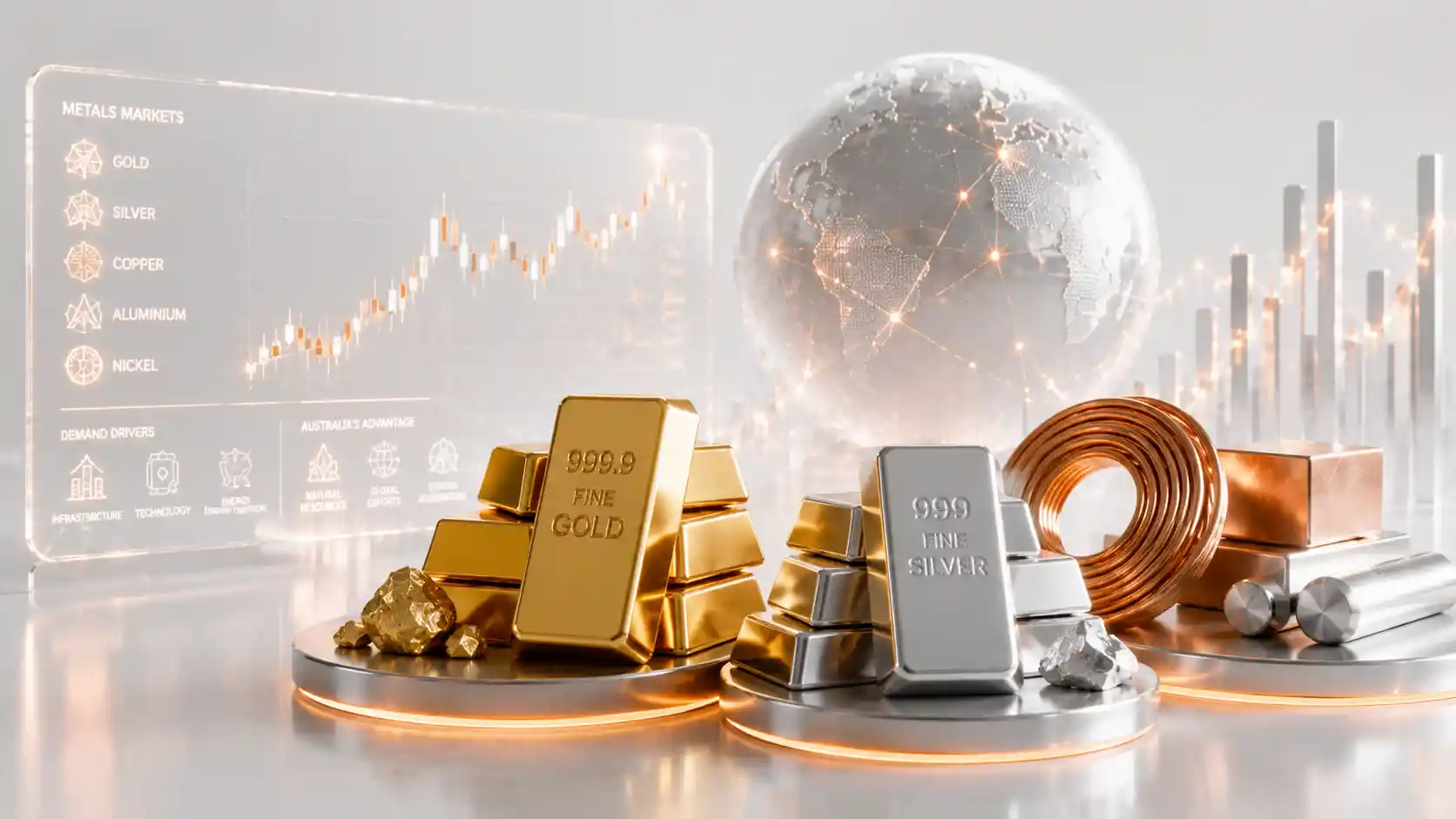
- Gold: the classic store-of-value metal, often linked to safety, central bank buying, monetary concerns and geopolitical uncertainty.
- Silver: part precious metal, part industrial input, often more volatile and pulled in two directions at once.
- Industrial metals: metals such as copper, aluminium, nickel and others tied more directly to construction, manufacturing, electrification and global growth.
Once you divide the space that way, your decisions become clearer. You are no longer asking “should I buy metals?” You are asking “do I want a monetary hedge, a hybrid precious-industrial exposure, or a direct growth-and-industry bet?” That distinction matters a great deal when building a portfolio.
Gold in Australian portfolios: insurance, signal or trade?
Gold remains the metal most people think about first, especially when considering its gold portfolio role. It is easy to understand why. Gold has symbolic power, long-term credibility and a reputation as a hedge against fear, inflation and monetary instability. In 2026, gold prices remained supported by safe-haven demand and continued central bank buying even after pulling back from earlier highs, according to World Bank commentary on precious metals. Reuters also reported in February 2026 that analysts had raised gold forecasts materially, with geopolitical uncertainty and strong central bank purchases cited as major supports.
But the practical role of gold is more complicated than the mythology suggests. Gold is not a magic shield that automatically rises whenever other assets fall. Sometimes it acts as a hedge. Sometimes it behaves like a crowded macro trade. Sometimes it simply consolidates while the market searches for a new narrative. For Australians, gold can play at least three different roles:
- Insurance: a modest allocation intended to reduce vulnerability to extreme geopolitical or monetary stress.
- Macro signal: a market indicator reflecting fear, real rate expectations or broad distrust in fiat systems.
- Trade: a tactical position based on momentum, technical structure or macro catalysts.
Problems arise when investors confuse those roles. If you buy gold as insurance, you should not panic if it underperforms for a quarter. If you buy it as a trade, you need an exit plan. If you watch it as a macro signal, you must avoid turning every price move into a personal forecast about the global system. Clarity of purpose makes gold far more useful.
Silver: the awkward and powerful middle ground
Silver is one of the most misunderstood metals because it sits between worlds. It shares some of gold’s safe-haven and store-of-value characteristics, but it also has real industrial uses in areas such as electronics, semiconductors and renewable technologies. The World Bank noted in June 2026 that silver prices, despite a sharp second-quarter decline, still averaged almost 100 percent above their 2025 annual average in the first half of 2026, with support from tight supply and industrial demand. The same update noted that silver is a key input in fast-growing sectors including renewable energy and semiconductors, though substitution risk remains relevant.
This hybrid nature gives silver both appeal and difficulty. It can participate in precious metal rallies, but it can also react to industrial optimism or pessimism. It is often more volatile than gold, which means it can outperform dramatically in bullish phases and disappoint just as dramatically during pullbacks. Reuters reported in early 2026 that analysts expected silver to remain highly volatile even as forecasts rose.
For an Australian portfolio, silver can make sense in a few situations:
- When you want exposure to precious metals but are willing to accept more volatility than gold.
- When you want a metal linked to both monetary uncertainty and industrial transition themes.
- When you are comfortable treating the position as a tactical allocation rather than a stable defensive anchor.
Silver is usually not the first metal to use if your main goal is calm portfolio insurance. But it can be compelling if you understand that you are buying a metal with two personalities, not one.
Industrial metals: the growth engine of the metals complex
Industrial metals tell a different story. Instead of fear and safety, they reflect production, infrastructure, technology and capital expenditure, giving investors broader Australian commodities exposure. When traders talk about copper as a barometer of economic health, they are pointing to this growth-sensitive function. In a resource-driven economy like Australia, industrial metals often matter as much as precious metals, if not more, because they sit closer to export flows, mining investment and the share prices of major listed companies.
Industrial metals may include:
- Copper, often linked to electrification, construction and infrastructure demand.
- Nickel and lithium, associated with batteries and energy transition supply chains.
- Aluminium, zinc and other inputs tied to manufacturing and industrial activity.
These metals are often less about crisis hedging and more about participating in structural trends. That can include energy transition themes, grid upgrades, electric vehicles, defence spending, construction cycles and emerging-market industrial growth. For Australians, industrial metals exposure often overlaps heavily with resource equities, so the portfolio question is not only whether the theme is attractive, but whether you already own too much of it through the ASX.
How metals fit into an Aussie-style portfolio
Australian portfolios often have built-in characteristics: home bias, meaningful exposure to banks and miners, property-linked thinking, and sensitivity to the local economy. Against that backdrop, metals can play different roles depending on what is missing or overrepresented.
| Metal Type | Primary Portfolio Role | Main Risk |
| Gold | Defensive hedge, macro insurance, diversification | Can underperform if real yields or risk appetite move against it |
| Silver | Hybrid precious-industrial exposure, tactical upside | High volatility and mixed driver set |
| Industrial Metals | Growth, infrastructure, electrification and commodity cycle exposure | Highly cyclical and sensitive to global slowdown |
In practical terms, an Aussie investor might use gold to offset macro uncertainty, silver as a smaller high-beta metals sleeve, and industrial metals as part of a long-term growth and resource thesis. But the weighting matters. A balanced portfolio uses metals to add resilience or targeted exposure, not to become a one-way bet on commodity strength.
The hidden overlap problem in Australian portfolios
One of the most important issues for Australian investors is overlap. A person may think they are “adding metals exposure” by buying gold miners, copper explorers or diversified miners, when in reality they already hold large mining weights through super, ETFs or broad ASX allocations. That means the new position may not diversify the portfolio at all. It may simply intensify existing exposure to the same macro forces.
This matters particularly with industrial metals. If a portfolio is already loaded with resource-linked equities, then adding more industrial metal exposure may increase sensitivity to Chinese demand, global construction activity, freight costs and cyclical sentiment. The trade might still be attractive, but it should be understood as concentration, not diversification.
Gold can sometimes help reduce this issue because its drivers can differ from those of industrial mining equities. However, even gold miners are still equities with business risks, cost pressures and management issues. So investors need to distinguish between owning the metal itself, owning a fund tracking the metal, and owning companies that produce it. These are related, but not interchangeable.
Metals as hedges against inflation and instability
One reason metals remain relevant is their relationship to inflation and uncertainty. Gold, in particular, is often used when investors worry about monetary instability, geopolitical stress or declining trust in paper assets. Silver may benefit from similar dynamics, though its industrial side complicates the picture. Industrial metals can also rise in inflationary periods, especially if infrastructure bottlenecks, supply disruptions or energy costs tighten the system.
But hedging with metals should be done honestly. A hedge is not supposed to make you rich overnight. Its job is to reduce vulnerability when specific risks intensify. That is why smaller, deliberately sized allocations often work better than oversized emotional positions. The investor who adds a controlled gold sleeve to balance equity and currency risk is usually in a better position than the investor who rushes into a full precious-metals narrative because the news cycle feels scary.
In 2026, the broader metals backdrop has been shaped by both strong demand narratives and volatility. The World Bank projected the precious metals price index to rise sharply in 2026 before easing in 2027, while also noting that risks remained tilted to the upside because of geopolitical tensions, policy uncertainty and financial volatility. That kind of backdrop supports the idea that metals can still matter as hedges, but only if investors accept that they are not linear or predictable.
How traders and investors use metals differently
Another source of confusion comes from mixing trading and investing. A trader may care about momentum, breakout levels and event risk. An investor may care about multi-year diversification, purchasing power and structural trends. Both approaches can be valid, but the same metal should not be handled identically in both cases.
For example:
- A gold trade might be based on a short-term macro catalyst, such as a change in rate expectations or a surge in geopolitical risk.
- A gold investment allocation might be held through multiple cycles as portfolio insurance.
- An industrial metals trade could focus on economic data surprises or commodity momentum.
- An industrial metals investment thesis could revolve around electrification, infrastructure and long-run supply constraints.
Investors often get into trouble when they enter a trade with no exit plan and later call it a “long-term investment” purely because it moved against them. The opposite happens too: people allocate to a long-term metals theme and then panic at the first drawdown because they were emotionally treating it like a short-term trade. Clear labels improve behaviour.
Practical ways Aussies can build a metals sleeve
Building metals exposure does not require turning your whole portfolio into a mining bet. A more thoughtful approach starts with purpose and then selects size and instrument accordingly. A simple framework could look like this:
- Define the purpose. Is the sleeve for diversification, inflation hedging, macro speculation, or structural growth exposure?
- Choose the metal group. Gold for defence, silver for hybrid upside, industrial metals for growth sensitivity.
- Check current overlap. Review how much mining and resource exposure already exists in super, ETFs and Australian shares.
- Set a position range. Use a percentage band that keeps metals meaningful but not dominant.
- Review quarterly. Reassess whether the sleeve is still serving the intended role rather than drifting into something else.
This type of structure can help Australians benefit from the country’s resource literacy without becoming captive to commodity cycles.
Why metals still deserve attention in a modern diversified portfolio
It is fashionable in some circles to dismiss hard assets as old-world relics or to treat them only as speculative vehicles. But that misses the broader point. Metals remain deeply connected to monetary systems, industrial development, technology and national balance sheets. In Australia, where the economy itself has strong resource roots, ignoring metals entirely can leave a portfolio blind to some of the most important forces shaping local and global markets.
The smarter path is not to worship metals and not to ignore them, but to place them correctly. Gold may deserve a modest defensive role. Silver may suit a more tactical investor who understands its volatility. Industrial metals may belong in portfolios that want measured exposure to growth, infrastructure and electrification themes. Used with discipline, metals can deepen diversification and sharpen macro awareness. Used carelessly, they can simply amplify concentration and emotion.
That is why metals trading for Australian portfolios is ultimately less about prediction and more about placement. In a resource-driven economy, the question is not whether metals matter. It is whether you are using them deliberately — or just being moved by them without noticing.
FAQs
What is the safest metal for beginner investors in Australia?
For most beginners, gold is generally considered the least volatile entry point into metals investing. Unlike industrial metals, its price is influenced more by monetary policy, inflation expectations and investor sentiment than by manufacturing demand. Gold is often used as a portfolio diversifier rather than a high-growth asset, making it suitable for investors looking to reduce overall portfolio risk rather than maximise returns.
Is physical gold better than gold ETFs?
Neither option is universally better—it depends on your objective. Physical gold offers direct ownership without counterparty exposure, making it attractive for long-term wealth preservation. Gold ETFs, on the other hand, provide greater liquidity, lower storage concerns and easier portfolio management. Investors seeking convenience often prefer ETFs, while those focused on long-term asset protection may favour physical bullion.
How much exposure to metals should an Australian portfolio have?
There is no universal allocation that suits every investor. Portfolio size, investment horizon and risk tolerance all influence appropriate exposure. Many diversified investors use metals as a complementary allocation rather than a core holding, ensuring they provide diversification without creating excessive concentration in commodity-related assets.
Why are Australian investors already exposed to metals without realising it?
Many Australian superannuation funds, ASX index funds and diversified ETFs already hold significant positions in mining companies. Large resource firms represent an important part of Australia’s equity market, meaning investors often have indirect exposure to metals even if they never buy commodities directly. Reviewing existing holdings before adding new metals positions helps avoid unintended concentration.
Are gold mining shares the same as owning gold?
No. Gold mining companies are equity investments, while gold itself is a commodity. Mining shares are influenced not only by gold prices but also by operational costs, management decisions, production issues, exploration success and overall stock market sentiment. During periods of market stress, mining stocks can behave very differently from physical gold.
Which industrial metals have the strongest long-term growth potential?
Copper is widely viewed as one of the most important industrial metals because of its role in electrification, power infrastructure and renewable energy systems. Nickel, lithium and aluminium also benefit from long-term trends such as electric vehicles, battery production and global infrastructure investment. However, each metal responds to different supply and demand dynamics, making diversification across industrial metals worth considering.
Can metals protect against inflation?
Metals can provide partial protection during periods of elevated inflation, but their performance is not guaranteed. Gold has historically been viewed as a store of value during monetary uncertainty, while industrial metals may benefit when inflation is driven by strong economic demand or supply shortages. Investors should view metals as one component of a broader risk management strategy rather than a perfect inflation hedge.