
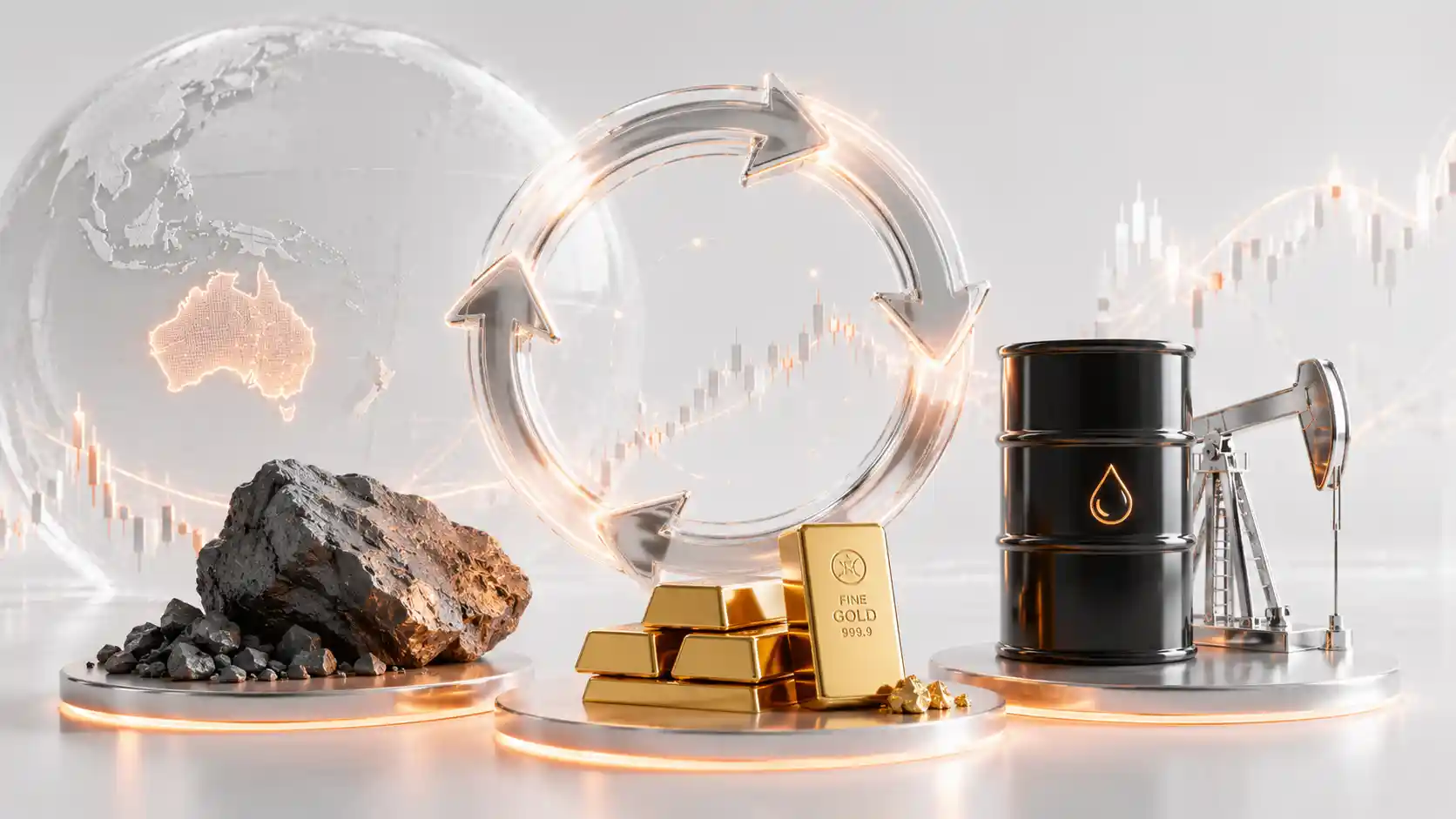
For Aussie traders, iron ore, gold and oil are not just tickers on a screen — they are pillars of the country’s economic story. Iron ore shapes export revenues and currency moves, gold influences perceptions of safety and monetary risk, and oil affects everything from transport costs to inflation. If you are trading from Australia in 2026, understanding how these three markets behave, how they interact with the resource cycle, and how they fit into an Aussie-style portfolio is essential. This guide dives into the current dynamics of iron ore, gold and oil, and explains how Australian traders can use them without turning exposure into uncontrolled risk.
The key to understanding the Australian commodities cycle is not to predict every twist in the resource cycle, but to recognise its major drivers. It is to help you recognise the main drivers, build more grounded trade ideas, and decide where these commodities belong in a broader mix of ASX shares, global stocks and other assets. For many Aussies, that shift — from guessing to structured thinking — is where resource trading starts to feel less like a punt and more like a deliberate part of the overall plan.
Why the resource cycle matters so much for Australia
Australia’s identity as a resource-heavy economy means global demand for iron ore, gold and oil often shows up quickly in local data, market sentiment and currency moves. When the resource cycle is strong, export earnings and related corporate profits can rise, supporting employment, investment and tax revenues. When it weakens, the effects can spread from mining regions to national accounts and investor confidence.
For traders, this makes the resource cycle a kind of backbone. It influences:
- The performance of ASX resource stocks and broader indices.
- The behaviour of the Australian dollar against major currencies.
- Inflation and rate expectations, especially when energy prices move sharply.
Ignoring iron ore, gold and oil from down under is like ignoring tide charts as a surfer. You can still paddle out, but you are doing it without understanding the rhythm underneath the waves.
Iron ore: the heartbeat of Australia’s export story
Iron ore is one of Australia’s most important exports. Demand from major steel-producing countries drives volumes and prices, while supply decisions from large miners shape how much ore hits the market. When iron ore prices are strong, the resource sector and government revenue often feel the benefits. When prices soften, project economics, budgets and sentiment can all come under pressure.
For traders, key iron ore considerations include:
- Demand cycles: construction and infrastructure trends, especially in major importing nations.
- Supply dynamics: production capacity, logistics constraints and policy changes affecting miners.
- Currency links: iron ore strength or weakness can influence the Australian dollar’s behaviour.
Iron ore exposure often comes via ASX-listed resource stocks rather than direct commodity instruments. This means traders are balancing both commodity dynamics and company-specific factors such as costs, debt levels and management decisions.
Gold: more than just a “safe haven” headline
Gold has long been associated with safety, but real-world behaviour is more nuanced. It can respond to interest rate expectations, currency shifts, risk appetite and inflation fears all at once. For Australian traders, gold plays several roles: a potential hedge, a speculative instrument and a symbol of how markets perceive monetary and geopolitical risk.
When thinking about gold, it helps to separate myth from mechanics:
- Gold can rise during periods of stress, but it can also fall if real yields move higher or the currency environment changes.
- It may act as a partial hedge, not a guaranteed shield, against equity volatility or inflation.
- Gold-related ASX stocks add another layer: company performance, costs, exploration success and operational risk.
For Aussies, gold works best when treated as one component in a larger system. It can support the portfolio when certain risks intensify, but it should not be the only answer to complex macro questions.
Oil: energy, inflation and global politics
Oil sits at the intersection of energy demand, supply decisions and geopolitics. Price moves can reflect shifts in production quotas, disruptions, economic expectations and policy changes. For Australians, oil influences fuel costs, transport expenses and parts of the inflation picture.
Traders down under who engage with oil need to understand:
- Supply agreements and policy decisions: how producers manage output and respond to demand.
- Economic cycles: higher growth often means higher energy consumption.
- Shock events: disruptions or tensions that can quickly move prices.
Oil-related trades can involve direct price instruments or equities exposed to energy markets. In practice, many Aussies find that combining moderate direct exposure with careful use of energy-linked shares helps balance liquidity and familiarity.
Iron ore, gold and oil in one view: how they interact
Looking at each commodity in isolation is useful, but the resource cycle becomes clearer when you see how iron ore, gold and oil interact. They do not always move together. In some periods, iron ore strength can coincide with gold weakness. In others, oil rallies may occur while metals stay flat.
A high-level way to think about their interactions is:
| Commodity | Primary Driver | Common Portfolio Role |
| Iron Ore | Global steel demand, resource sector cycles | Exposure to Australia’s export strength and resource companies |
| Gold | Monetary conditions, sentiment, currency dynamics | Partial hedge, store-of-value narrative, macro signal |
| Oil | Energy demand, supply decisions, geopolitics | Energy exposure, inflation-linked hedge, risk indicator |
This view helps Aussies avoid treating “resources” as a single theme by recognising where the metals market cycle differs from iron ore and energy trends. Iron ore aligns more with growth and infrastructure cycles, gold with monetary and sentiment forces, and oil with energy and geopolitical dynamics. Using all three in one portfolio demands respect for those differences.
Building trade ideas around the resource cycle
Riding the resource cycle does not mean guessing every peak and trough. It means shaping trade ideas around identifiable drivers and ensuring those ideas fit within your overall risk limits.
A practical way to build ideas might look like this:
- Start with a narrative: identify whether the current environment looks like early expansion, mid-cycle strength, late-cycle fatigue or a downturn.
- Map that narrative to resource sectors: ask how iron ore, gold and oil typically behave in that phase.
- Choose instruments: decide whether exposure should be through direct commodity products, resource stocks or a mix.
- Define entry and exit conditions: set clear price, data or time-based triggers for entering and leaving positions.
- Size positions consciously: limit the impact of any single resource theme on your total portfolio.
Traders who follow this path are less likely to jump into resource moves purely out of fear or excitement. Instead, they attach trades to a structure they can explain to themselves even when prices are moving quickly.
Risk management when riding the resource cycle
Resource markets can move fast. Iron ore prices may swing on policy comments, gold can react to rate expectations, and oil can move on sudden headlines. Without strong risk management, riding the resource cycle can easily turn into being thrown around by it.
For Aussies using commodities trading down under, a few guardrails make a big difference:
- Position limits: cap how much of your portfolio can be tied to iron ore, gold and oil at any given time.
- Instrument choice: favour tools with liquidity and transparent pricing; be careful with exotic leveraged products.
- Stop-loss and review points: predefine levels or conditions that trigger reassessment rather than waiting until stress is high.
- Diversification: remember that resource trades should complement, not replace, other portfolio exposures.
At Langston Wealth commoditiy market access, the conversation often returns to the difference between hedge and bet. A hedge reduces vulnerability to specific shocks. A bet increases dependence on a particular outcome. Resource trades can be either, depending on size, structure and intention.
Iron ore and the ASX: being honest about concentration
Australian traders already have resource exposure simply by owning the local market. Large miners and related companies occupy meaningful slices of major indices. When adding iron ore-linked trades, it is important to recognise how much resource risk you already carry.
Honest questions include:
- How much of my equity portfolio is already driven by resource cycles?
- Will new iron ore exposure genuinely diversify, or just compound that risk?
- Am I prepared for the combined effect of equity and commodity moves in a downturn?
Answering these questions before entering new positions helps avoid unintentionally building a portfolio that lives or dies on one part of the resource cycle.
Gold in today’s markets: between narrative and numbers
Gold often attracts strong stories. Some see it as a permanent hedge, others as outdated. In current markets, the reality sits in the middle. Gold can respond to interest rates, currency moves, inflation expectations and stress, but the mix changes over time.
For Aussies considering gold, it is useful to:
- Observe how gold behaves alongside equities, bonds and currencies in practice, not just in theory.
- Decide whether its primary role in your portfolio is diversification, hedge, or speculation.
- Limit gold exposure so that it enhances resilience rather than becoming the main story.
Treating gold as a flexible tool, rather than a rigid symbol, tends to produce more realistic expectations and reduces the risk of disappointment when behaviour does not match simple slogans.
Oil in today’s markets: linking energy to everyday life
Oil’s influence on Australian life is often felt at the petrol station and in business costs, but for traders it runs deeper. Large moves in oil can shift inflation conversations, profit margins and sentiment about global growth. Understanding this connection helps resource trades feel less abstract.
Practical considerations include:
- Recognising that oil-related trades are intertwined with views on growth and inflation.
- Being realistic about how quickly oil can move on news, and building risk controls accordingly.
- Using oil exposure in combination with other assets rather than as a single proxy for all energy risks.
For many Aussies, a modest, well-managed link to oil can add valuable context to portfolios that already react strongly to local energy costs and global macro shifts.
FAQs about riding the resource cycle
Do I need to trade iron ore directly to benefit from the resource cycle?
Is gold still useful if it sometimes moves like a risk asset?
Gold can still be useful, but expectations should be realistic. It may act as a partial hedge or diversifier rather than a guaranteed opposite to equities. Understanding its behaviour across different environments helps you size and place gold appropriately in your portfolio.